Context
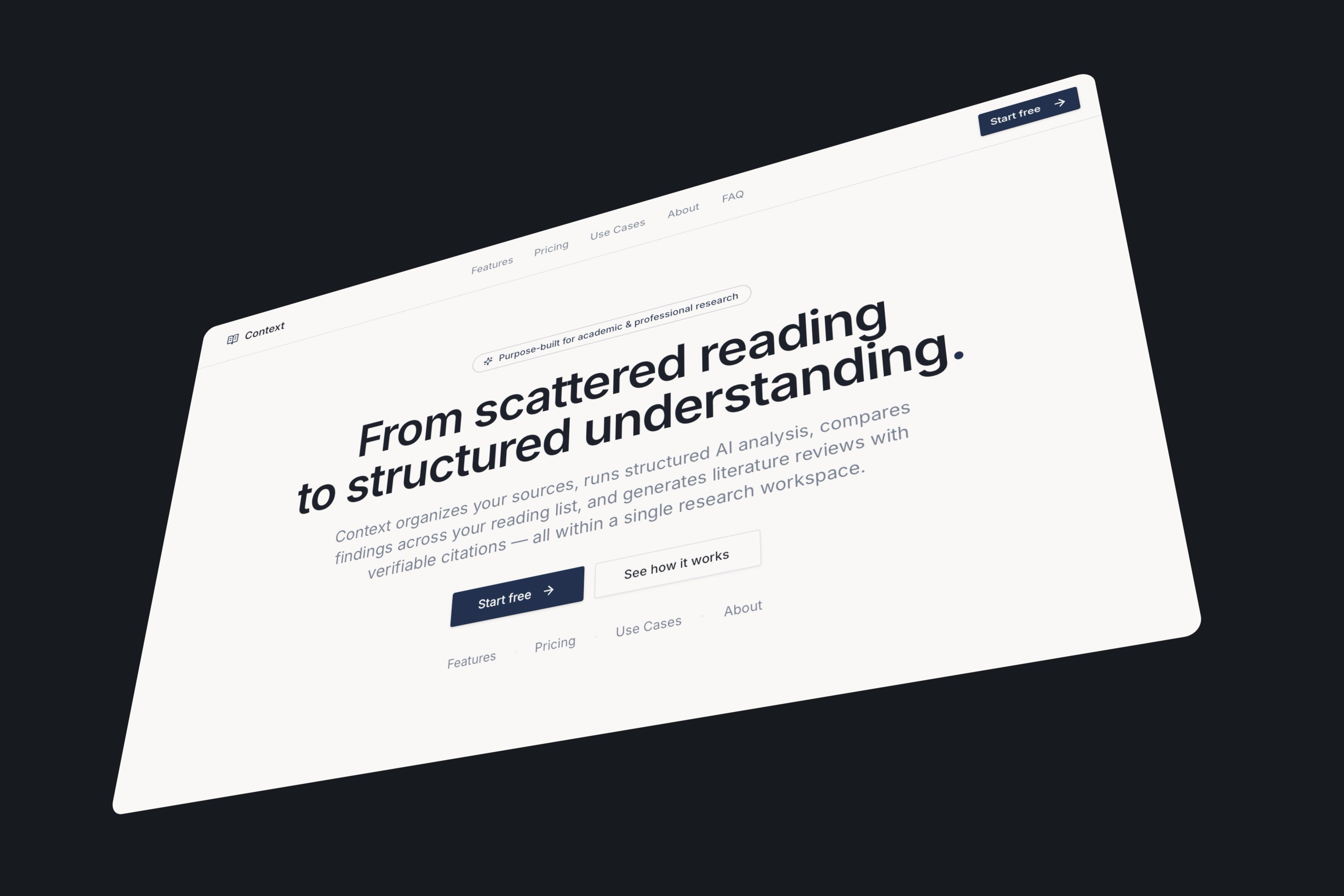
A research-native AI workspace that turns scattered reading into structured understanding, organizing sources, running grounded analysis across them, and producing literature reviews with fully traceable citations.

Context is a web application purpose-built for academic and professional research. It helps researchers move from a pile of sources to a clear understanding of what the literature actually says, where the evidence is strong, where it is contested, and where it is absent. Unlike generic AI tools that generate text from the open internet, every output in Context is grounded in the sources the user chooses and is traceable back to a specific document.
Purpose
I built Context to close the gap between reading widely and understanding deeply. Serious research work requires more than fluent summaries: it requires a structured view of claims, methods, and evidence across a body of sources, and writing outputs that can be verified. Context exists to make that kind of intellectual work faster, cleaner, and fully auditable.
Audience
The project is built for people doing serious reading for a living: academics, graduate students, policy analysts, journalists, and professional researchers who need to synthesize large reading lists into literature reviews, briefings, or arguments — and who need their citations to be real.
Role
I lead the project end to end, across product direction, editorial voice, and positioning.
Product direction and feature scope
Research workflow design (sources, analysis, comparison, output generation)
Editorial voice across the marketing site and in-product copy
Positioning and messaging
Brand system and visual direction
Beta program design and user feedback
Process
The central decision was to build Context as a structured tool rather than a generative one. Instead of producing text from the internet, the system reads the sources a user provides and extracts a structured representation of each one (summaries, claims, methods, evidence types), which then drives every downstream output. A second key decision was to make traceability a first-class requirement: every claim in a generated literature review links back to a specific source record, so nothing in the output is unverifiable. The workflow itself was shaped around how research actually happens: create a workspace around a question, upload sources, run analysis, compare across the corpus, generate outputs, and export or refine.
Outcome
Context is currently in closed beta with a small group of early users across academic and professional research contexts. Early feedback has centered on two things: the time saved when comparing sources side by side, and the confidence that comes from outputs whose citations are all verifiable. The product is continuing to develop in public, with new features shaped directly by beta users' workflows.
Building Context has deepened a conviction that runs through most of my work: that serious intellectual work deserves tools designed for understanding, not just for output. The more powerful generative AI becomes, the more valuable it is to build systems where every claim is anchored to a real source and every step of the reasoning is visible. That principle sits at the center of how Context is designed and how it will continue to evolve.